
Dancing This Mess Around
how the B-52's shook me

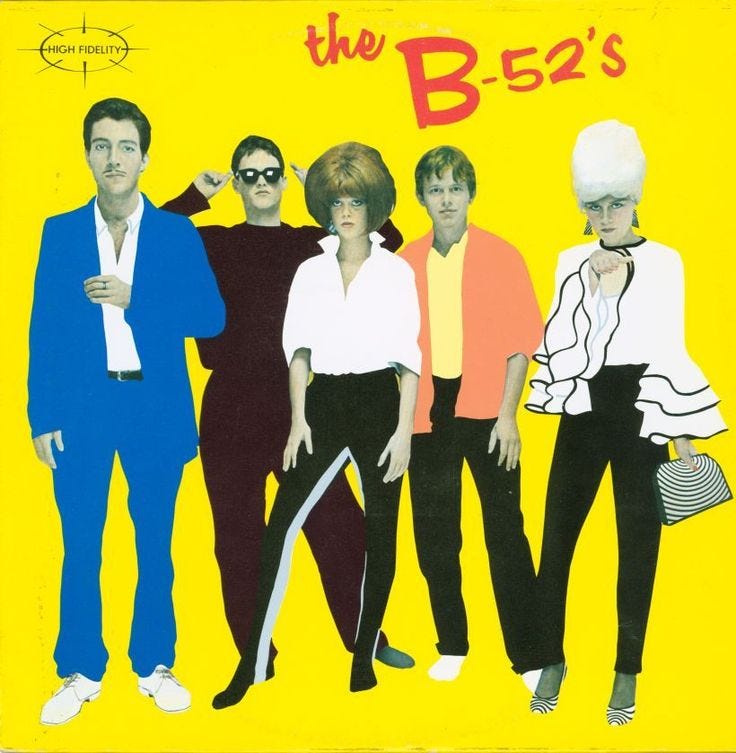
Similar to the pulsar of Joy Division’s Unknown Pleasures (see previous post), “Planet Claire” arrives like a message from outer space. The song’s opening Morse code sounds almost tired, as if it has traveled a great distance across time to wiggle your eardrums.
In stark contrast to Joy Division’s brittle chiaroscuro landscape, “Planet Claire” soon comes alive with sci-fi B-movie color. Think sexy, green-skinned alien with a lavender updo in a shimmering mini-dress casually casting aside her silver ray gun in favor of an intergalactic kiss with the square-jawed Earthman who just landed his toy spacecraft on her home world’s papier-mache volcano surface.
The song’s brief Sputnik intro gives way to a bongo-synthesizer-surf guitar sway that delivers serious camp while building to an irresistible groove.
On this Forbidden Planet, everyone must dance!
Once “Planet Claire,” the first track on The B-52’s eponymous 1979 debut gets the blood pumping, “52 Girls” kicks the party into rock steady gear. The band’s two, female, famously bouffant wig wearing singers chant (only 23) quintessentially American women’s names (Madge, Hazel, Mavis, Suzie, Anita) over a driving drum beat, accompanied by an exceedingly persuasive guitar riff peppered with Farfisa organ stabs. “When the names of Sixties pop icons like Gilligan’s Island sex-pot Tina Louise, Brenda Starr or “Jack Jackie-O” emerge out of the blur of ‘52 Girls’ (‘These are the girls of the You! S.A.’), it’s as if the band were resurrecting long-lost patron saints.”
Side one moves through “Dance This Mess Around" before landing on the shores of “Rock Lobster” to conjure a nocturnal zombie version of Frankie Avalon and Annette Funicello’s Beach Blanket Bingo movies, which appeared on Saturday afternoon TV throughout my childhood. The beautiful, brightly clad “teens” dancing on Hollywood back lot sand in those cheesy sixties flicks take on a ghostly video quality that haunts The B-52’s insistently contemporary sound. All the ancient pop references within their music feel like magnetic dust clinging to the band’s performance art aesthetic.
This debut album showed me how to love pop trash without shame. The cultural detritus they used to build their unique sound was worth donning like a campy wig, worth singing its praises as loudly and with as much wit as you can muster. (Find weekly examples in this blog’s previous posts.)
The recording’s rough, unpolished quality, especially on side one’s four instant classics, captures the live echo of parties full of writhing freaks in thrift shop fashions that gave birth to its distinctive sound. By the time The B-52’s hit the stores and found its way to me, the band that produced it had already moved past this proto-primitive phase, heading toward a more polished and popular approach.
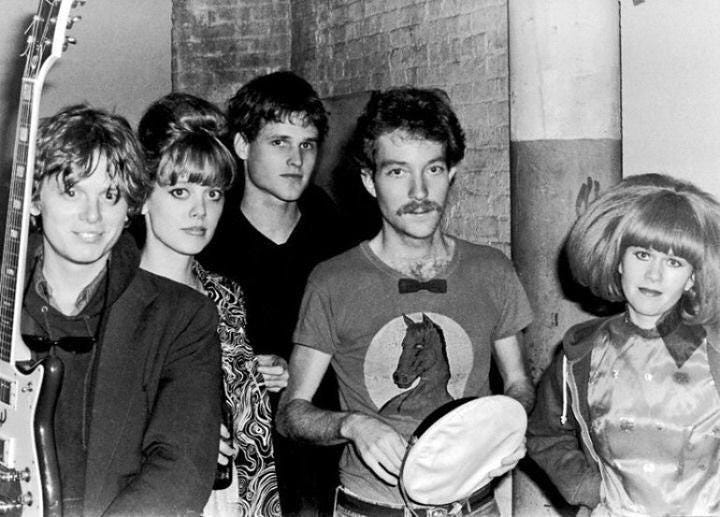
True of most rock band debuts -- documents of like-minded people coalescing around a shared vision, lifted up on the shoulders of those who love them, and (through great effort and endless repetition) foisted into the cultural fray -- the album is a chronicle of a place (Athens, GA) and a view of a world the band set out to change in some small way.
While The B-52’s remains singular in its style and vision, and became soundtrack to future fun, the blowouts from which it sprang can still be heard in the music -- the cosmic microwave background noise of a subculture’s big bang. For my 15 year old self, the 1979 album was the first crash of a New Wave, which became a tsunami after the launch of MTV in August 1981.
The B-52’s represents hope or the developing Polaroid image of it, ever so slowly fading in. Maybe I could find my way into a creative community before it imploded. Maybe that implosion will transmit evidence that I was once here and had something to say.
Maybe I will one day have something to say.
Play “There’s a Moon in the Sky (Called the Moon)” on The B-52’s B-side for reassurance: “If you’re in outer space, don’t feel out of place. Cause there are thousands of others like you. Others like you.”
“Others LIKE you.”
I remember bringing this bright yellow album home, commandeering the family console stereo, and infecting the living room with its gleeful mayhem. We were in the middle of a hard time, having recently suffered a financial meltdown, lost our home, and moved to a rundown rental in a tiny nearby town with no amenities on main street — no groceries or fast food, just an antique grain silo and a farm supply.
It is hard to believe how alien The B-52’s sounded when it first arrived. My step-father, who favored the southern California soft rock smoothness of The Eagles and their Laurel Canyon ilk, just laughed and laughed. He couldn’t understand what he was hearing. My parents had encountered some weirdness, but this was different -- crisp and aggressive even in its wacky playfulness. The faces they made on first listen were classic, physically cocking their heads, lifting one ear into the air, like dogs trying to understand a foreign language. This unfamiliar clatter provided yet another clue that something was going awry with their kid.
The verdict was swift: “This isn’t music.”
My step dad’s dismissal was easily arguable. The group’s sixties roots are clearly declared in their bare bones cover of Petula Clark’s “Downtown,” or more prominently on hit single “Dance This Mess Around,” which begins with an interpolation of The Supremes’ “Stop! In the Name of Love.”
“Walk, talk in the name of love. Before you beak my heart. Think it over. Roll it over in your mind.” But no one could predict, who would ever expect, this pointed advice to be followed with the desperate plea: “Why won’t you dance with me, I ain’t no Limburger?”
Singer Cindy Wilson wonders repeatedly what’s preventing her dance card from being punched before Fred Schneider redirects her attention to the dance floor where it belongs. And then the party, where we will do all 16 (fictional, I think) dances including the hip-o-crit, the aqua velva, and the dirty dog, really kicks in.
Having passively soaked up the prehistoric rhythms and melodies found on my parents’ collection of Original Sound’s Oldies But Goodies compilations, even I could hear primordial rock elements excavated in The B-52’s music. The band’s stripped-down style evokes the swampy, Athens, Georgia air that birthed it, saturated with the drive-by car radio ubiquity of late-1950s and early-1960s Doo Wop and Rock ‘n’ Roll the Oldies But Goodies collections revived for reevaluation in the mid-seventies.
The “proto” quality of Dee Dee Sharp’s “Mashed Potato Time,” Gene Chandler’s “Duke of Earl” and Shirley and Lee’s “Let The Good Times Roll” can be carbon dated in the bones of The B-52’s pogoing skeletons.
Yet the songs were also described as “drivingly modern, aggressively forward, with all the signposts (sexual and otherwise) obscured. This group turns the great American teenage tale of cruising and parties and beaches into a science-fiction fantasy… the conjunction of the planets treated as the universe’s biggest pajama party.”
Most of the songs feature Fred, Kate, and Cindy performing their own twisted version of Gospel call and response, hyping one another, building energy, devoting themselves to the almighty beat. “They are the one true new-age dance band. You either understand rhythm and shape or you don’t, and The B-52’s shudder with the stuff.”
To me, The B-52’s were hosts to a party going quickly out of bounds in a warehouse on the edge of a town that was crashing headlong into the Reagan eighties, resurgent conservatism, rampant consumerism, and the rise of the “greed is good” aesthetic.
All the more reason to dance a little faster, faster than you safely can.
The B-52’s communicates through its angular surf guitar surge exactly how to move. The smooth, satin-covered curves of disco are sharply thrust aside by the jerky spasms of someone going off their meds. Early ADHD.
My body responded to its call, twitching with the noise — head jerking, shoulders and arms flailing, like a butterfly struggling to extract itself from a cocoon — or (more accurately) a moth wiggling free to head directly toward some beckoning flame.
especially love the final print
This essay brings back colorful half buried memories from my fragmented teen years. And may I just sit in rapt adoration at your deft, compelling literary style?